History
- Overview / Virtual Tour
- Interior of the Building
- Exterior of the Building
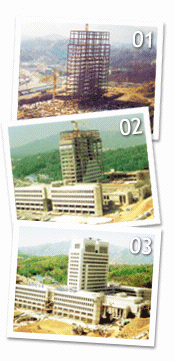
The first Supreme Court building was constructed in 1928 on a 24,000 square meter site at 37 Seosomun-dong, Jung-gu, Seoul. The total building area was approximately 10,300 square meters. To accommodate the growing organization in terms of both size and staff, the Court's first and second annex buildings, measuring 1,400 square meters and 3,200 square meters each, were added in 1957 and 1968, respectively.
The Supreme Court moved to its current building situated at 217 Seocho-ro, Seocho-gu, Seoul in 1995, which was the year marking the centennial anniversary of the establishment of the modern judiciary system in Korea. The construction of the building began on November 29, 1991 and was completed on September 23, 1995. The opening ceremony for the building took place on December 1, 1995. The building stands on an area of 57,700 square meters with an approximate total space of 66,500 square meters and consists of 16 floors and two underground floors.
The current building is divided into four sections: the Main Center, East and West Wings and Courtrooms. The Main Center is mostly occupied by the Supreme Court, East Wing by the National Court Administration and West Wing by the Supreme Court Library and other welfare facilities.
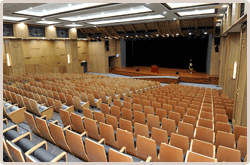
The auditorium seats 660 persons and is used for events such as the opening of the year ceremony, academic symposiums, movie presentations and others. During a Supreme Court tour, the visitors can view the Supreme Court introductory DVD inside the auditorium.
The exhibition room is located on the first floor of the Supreme Court building with a size of 138 square meters. The main theme of the exhibition room is 100 Years and the Future of the Judiciary. The room exhibits historical documents, books, judicial robes, and other items of the Judiciary. Also, visual films are shown in the room.
The room displays the portraits of successive Chief Justices. Also displayed are articles of the late judge KIM Hong-sup (1915-1965), who is deeply respected for his modest life and deep affection toward the people.
The room displays the portraits of successive Chief Justices. Also displayed are articles of the late judge KIM Hong-sup (1915-1965), who is deeply respected for his modest life and deep affection toward the people.
The Main Courtroom is where all Justices sit en banc to hear a case. It has a seating capacity of 310. It has extra space at each end, reserved for additional Justices expected to join the bench after the reunification of the Korean peninsula.
In addition to the Main Courtroom, the Supreme Court has two smaller courtrooms where a panel of four Justices hear a case. Each courtroom has a seating capacity of 140. Each panel of four Justices sits every two weeks to hear cases. A decision by the panel must be unanimous; otherwise, the case is referred to an en banc session.
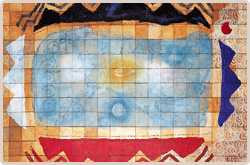
On the west and the east wall of the main entrance, oil paintings on bronze are displayed. The painting on the east wall represents the dawn, sunrise, hopes, plans and dreams. The main color is blue, which symbolizes the east of the orient. The painting on the west wall visualizes a trial of justice and is expressed in white.
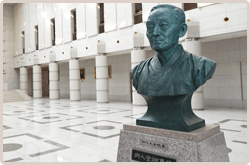
The late first Chief Justice, KIM Byong-ro was born as the only son among three siblings, in Sunchang, Jeonbuk, in 1887. He was appointed as a judge in 1919, and served as a lawyer from 1920. He defended more than 100 cases related to anti-Japanese colonialism. In August 1948, he was appointed as the first Chief Justice of Korea and served until December 1957. He passed away in January 1964 at the age of 77.
The late Chief Justice Kim is one of the most respected legal professionals in Korea for his honesty, strength and fortitude. His righteous and firm attitude became the motivating forces toward defending judicial independence and authority from external pressures.
The late Chief Justice Kim is one of the most respected legal professionals in Korea for his honesty, strength and fortitude. His righteous and firm attitude became the motivating forces toward defending judicial independence and authority from external pressures.
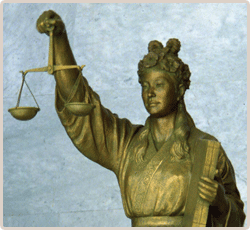
The Goddess of Justice representing law and justice may be considered as a western concept. However, this work of art is unique in that it portrays Korean features. As for its physical appearances, its face expresses gracefulness of a Korean woman and is dressed in a Korean traditional costume. The significant feature of this statue is that a scale of justice is held by one hand and the code of laws by the other instead of a sword.
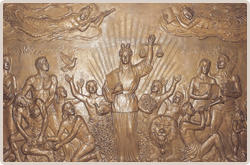
Titled Freedom·Equality·Justice, this bronze piece measures 800cm in width and 340cm in length. The theme of this embossed carving is Goddess of Justice with the crowd, symbolizing that as law and justice are inseparable from human lives, freedom, equality and justice should be made accessible to all members of the public.
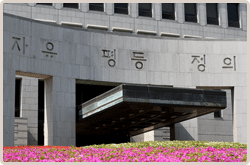
The words Freedom·Equality·Justice engraved in Korean represent the pledge made by the Supreme Court to uphold law and justice.
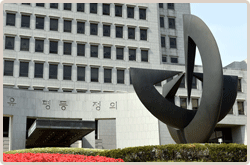
This formative bronze masterpiece measures six meters in both width and length and stands seven meters tall. Representing the strictness and dignity of law, the outer vertical ring was modeled after the horn and tail of the mythical creature Haitai that symbolizes law and justice of Korea. The inner horizontal ring represents the scale of justice, which symbolizes balancing of law, love and protection.
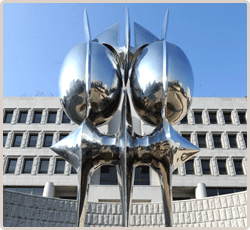
Made of stainless steel, measuring 220 cm by 100 cm and 550 cm, this art piece displays the same forms on each side of its axis, which symbolizes solemn order and the harmony of nature.